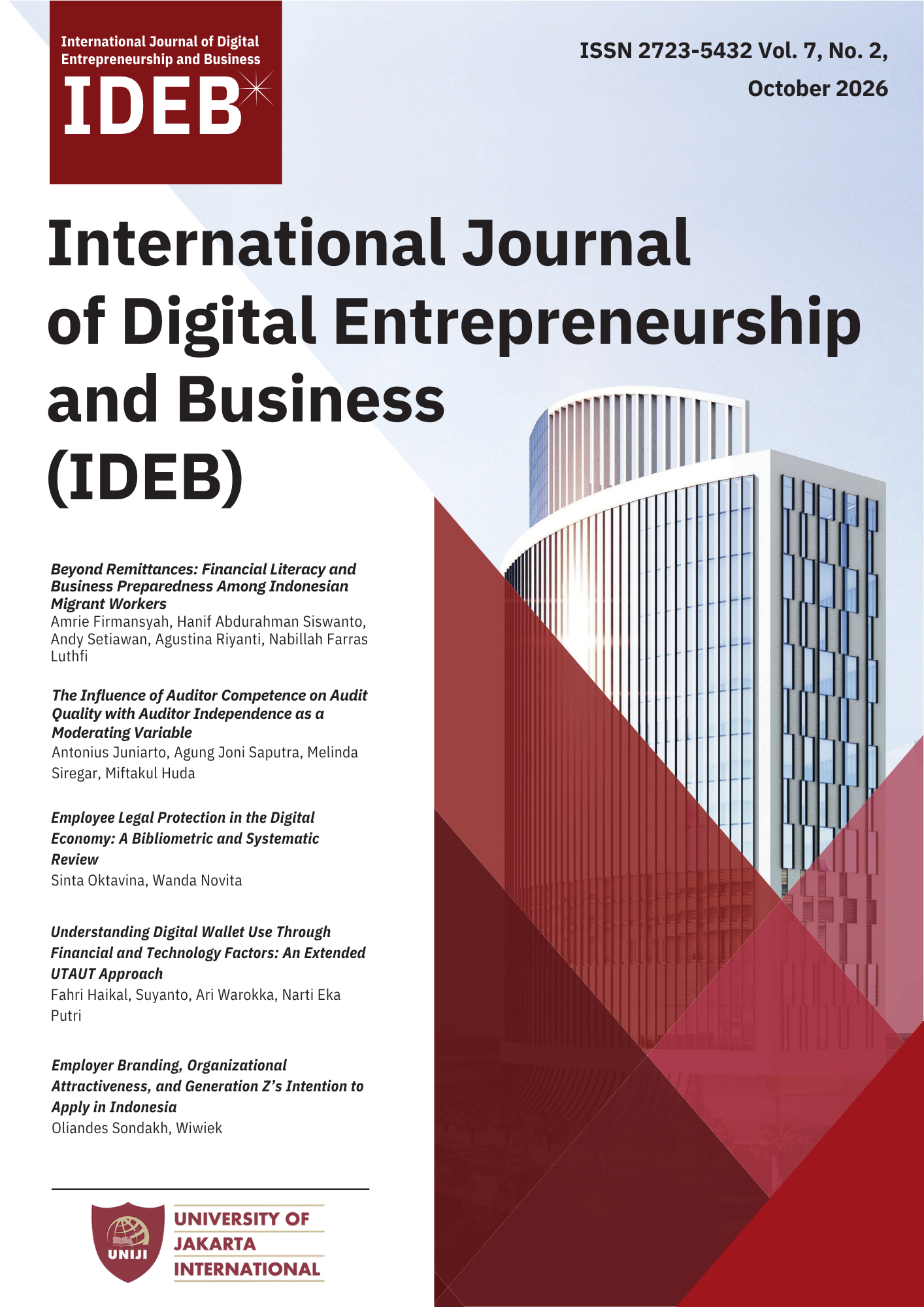
Employer Branding, Organizational Attractiveness, and Generation Z’s Intention to Apply in Indonesia
DOI:
https://doi.org/10.52238/ideb.v7i2.413Keywords:
employer branding, organizational attractiveness, intention to apply, generation z, signaling theoryAbstract
This study examined whether employer branding influences Generation Z job seekers’ intention to apply directly or through organizational attractiveness, responding to inconsistent evidence on the direct link between employer branding and application intention. Drawing on signaling theory and the instrumental–symbolic framework, a cross-sectional online survey was conducted in Indonesia among 300 active job seekers born between 1997 and 2000, who were selected through purposive sampling. The data were analyzed using partial least squares structural equation modeling. Employer branding had a strong positive effect on organizational attractiveness (β = 0.772), and organizational attractiveness had a positive effect on intention to apply (β = 0.547). The direct effect of employer branding on intention to apply was small and not significant (β = 0.118), whereas the indirect effect through organizational attractiveness was positive and significant (β = 0.422), indicating indirect-only (full) mediation. These results showed that employer signals shaped application decisions mainly when job seekers translated them into a favorable evaluation of the organization as a place to work. Theoretically, the study positions organizational attractiveness as the evaluative mechanism that links employer signals to behavioral intention; practically, it suggests that employers should invest in credible, experience-based value propositions rather than in visibility alone. The study is original in testing this mediation among older Generation Z active job seekers in Indonesia, a segment largely overlooked by prior student-based studies.
Downloads
Downloads
Published
How to Cite
Issue
Section
License
Copyright (c) 2026 Oliandes Sondakh, Wiwiek .

This work is licensed under a Creative Commons Attribution 4.0 International License.
 Abstract viewed = 0 times