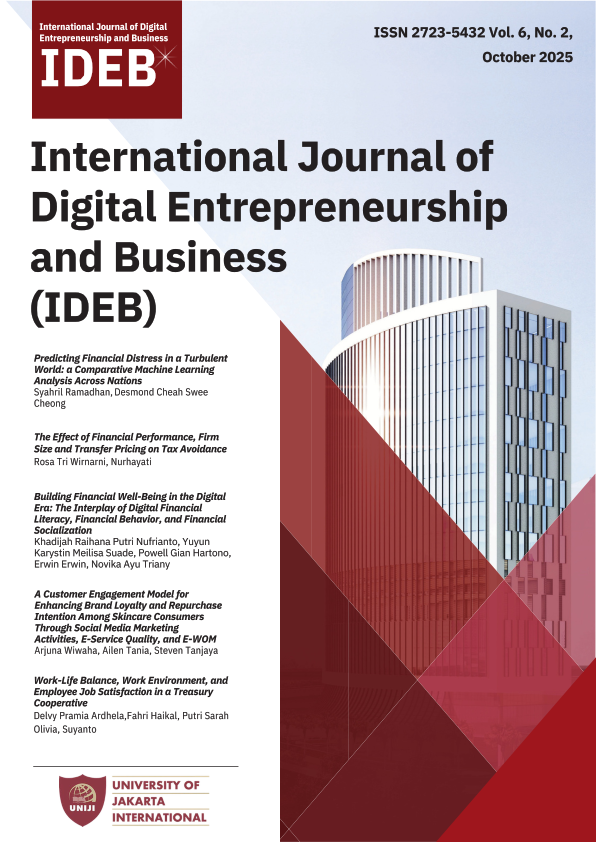
Building Financial Well-Being in the Digital Era: The Interplay of Digital Financial Literacy, Financial Behavior, and Financial Socialization
DOI:
https://doi.org/10.52238/ideb.v6i2.391Keywords:
Digital Financial Literacy, Financial Behavior, Financial Socialization, Financial Well-Being, Productive-Age Population, IndonesiaAbstract
The rapid expansion of digital financial services has transformed the way individuals manage their personal finances, particularly among productive-age populations who actively engage with financial technology. While digital financial inclusion continues to increase in Indonesia, disparities between financial access and financial literacy remain a significant challenge, potentially affecting individuals' financial well-being. This study aims to examine the influence of digital financial literacy, financial behavior, and financial socialization on the financial well-being of Indonesia's productive-age population. A quantitative research design was employed using a structured online questionnaire distributed to individuals aged within the productive workforce who had at least two years of work experience and had used digital financial services. The collected data were analyzed using Structural Equation Modeling–Partial Least Squares (SEM-PLS). The findings indicate that digital financial literacy, financial behavior, and financial socialization each have a positive and significant effect on financial well-being. Individuals with stronger digital financial competencies, healthier financial behaviors, and greater exposure to financial socialization demonstrate higher levels of financial well-being. These findings highlight the importance of integrating financial education, behavioral development, and social influences to improve financial well-being in the digital era. The study contributes to the behavioral finance literature by providing empirical evidence from Indonesia's productive-age population and offers practical implications for policymakers, financial institutions, and financial education providers in designing programs that strengthen digital financial capability and sustainable financial well-being.
Downloads
Downloads
Published
How to Cite
Issue
Section
License
Copyright (c) 2026 Khadijah Raihana Putri Nufrianto, Yuyun Suade, Powell Gian Hartono, Erwin Erwin, Novika Ayu Triany

This work is licensed under a Creative Commons Attribution 4.0 International License.
 Abstract viewed = 129 times